
Xinhua- El éxito histórico de China en la reducción de la pobreza ha ido más allá de las teorías actuales contra la pobreza y puede ofrecer perspectivas y experiencias frescas a la lucha global contra este flagelo, según un informe de investigación emitido hoy domingo.
El milagro de la reducción de la pobreza ha dado a luz un nuevo campo de investigación, según el informe titulado "Estudios sobre el alivio de la pobreza de China: Una perspectiva político-económica" lanzado por New China Research (NCR), un grupo de expertos de la Agencia de Noticias Xinhua.
El informe recurre a los discursos sobre el alivio de la pobreza del presidente chino Xi Jinping como fundamento ideológico y teórico, y decodifica la "fórmula para ganar" en la lucha contra la pobreza del país, al mismo tiempo que explora las razones que hay detrás de la lucha y discute sus implicaciones globales.
"En base a nuestras condiciones nacionales y siguiendo la ley de la reducción de la pobreza, China ha adoptado una serie de políticas y medidas extraordinarias y ha construido un conjunto completo de sistemas, incluyendo políticas, empleo e instituciones, para abrir un camino de reducción de la pobreza y formar una teoría contra la miseria con características chinas", sostuvo Xi, citado por el documento.
En los pasados ocho años, los últimos 98,99 millones de residentes rurales empobrecidos de China que vivían bajo el umbral actual de la pobreza han sido sacados de la miseria. El país ha cumplido la meta de erradicar la pobreza establecida en la Agenda 2030 para el Desarrollo Sostenible de la ONU diez años antes de lo previsto.
La reducción de la pobreza de China muestra una teoría de economía política de distribución favorable tanto para la reducción de la pobreza como para el desarrollo, que tiene como objetivo mantener la prosperidad común nacional con la construcción de un "mercado favorable a los pobres", en el que el gobierno, el mercado y la sociedad trabajan juntos para emancipar la productividad de los pobres, para que éstos hagan su contribución al crecimiento, señala.
En las medidas precisas de mitigación de la pobreza, la "mano visible" de un gobierno capaz no es una "mano incansable" sino una "mano habilitante", según el informe, que también indica que un mercado efectivo favorable a los pobres no es una distorsión del mercado, sino una reconstrucción del mercado.
Considerando a China como "estudiante, beneficiaria e innovadora de las teorías globales de alivio de la pobreza", el documento resume los puntos de vista de expertos extranjeros sobre las inspiraciones que genera China para el mundo como las "cinco D", a saber: liderazgo Determinado, proyecto Detallado, Desarrollo orientado, gobernanza basada en Datos, y ejecución Descentralizada.
"China está haciendo una devolución a la causa de la humanidad para terminar con la pobreza y está ofreciendo una nueva referencia a otros países y regiones, basándose en sus propias experiencias e ideas teóricas en el alivio de la pobreza", destaca el informe.
Xinhua Headlines: Special study unveils what China has to share on fighting poverty
-- China's poverty reduction miracle has given birth to a new field of study, according to the report titled "Chinese Poverty Alleviation Studies: A Political Economy Perspective" released by New China Research, the think tank of Xinhua News Agency.
-- The report, drawing on Chinese President Xi Jinping's discourses on poverty alleviation as the ideological and theoretical foundations, decodes the "winning formula" in China's anti-poverty fight, explores the rationale behind the fight and discusses its global implications.
-- The report summarized Xi's discourses on poverty alleviation as "seven upholds": upholding the leadership of the Communist Party of China, a people-centric approach, joint actions to tackle challenges, a strategy for precision, self-reliance, shared development, and a realistic and pragmatic approach.
-- The report summarized foreign experts' views of Chinese inspirations for the world as "5Ds:" Determined Leadership, Detailed Blueprint, Development Oriented, Data-based Governance and Decentralized Delivery.
BEIJING, Feb. 28 (Xinhua) -- China's history-making success in poverty alleviation has gone beyond established anti-poverty theories and can provide fresh perspectives and experiences for the global fight against poverty, said a research paper released on Sunday.
The poverty reduction miracle has given birth to a new field of study, according to the report titled "Chinese Poverty Alleviation Studies: A Political Economy Perspective" released by New China Research, the think tank of Xinhua News Agency.
The report, drawing on Chinese President Xi Jinping's discourses on poverty alleviation as the ideological and theoretical foundations, decodes the "winning formula" in China's anti-poverty fight, explores the rationale behind the fight and discusses its global implications.
"Based on our national conditions and following the law of poverty reduction, China has adopted a series of extraordinary policies and measures and constructed a whole set of systems covering policy, work and institutions, blazing a poverty reduction path and forming an anti-poverty theory with Chinese characteristics," it cited Xi as saying.
The report summarized Xi's discourses on poverty alleviation as "seven upholds": upholding the leadership of the Communist Party of China (CPC), a people-centric approach, joint actions to tackle challenges, a strategy for precision, self-reliance, shared development, and a realistic and pragmatic approach.
Female employees make garments in a poverty alleviation workshop in Tongxin County, northwest China's Ningxia Hui Autonomous Region, Feb. 24, 2021. (Xinhua/Wang Peng)
THE "WINNING FORMULA"
Over the past eight years, China's final 98.99 million impoverished rural residents living under the current poverty line have all been lifted out of poverty. The country has met the poverty eradication target set in the United Nations' 2030 Agenda for Sustainable Development 10 years ahead of schedule.
A "winning formula" in China's poverty alleviation efforts was holding onto positive dialectical thinking and improving the pro-poor market mechanism under the guidance of the government, said the report.
In China, the "burden" of poverty has been turned into a source of potential, and human and natural resources in poor areas have become a means to achieve common development and prosperity, it said.
By capitalizing on local natural resources, many poverty-stricken areas have developed various businesses and subsequently boosted local economic growth and created job opportunities, the report finds.
From a political economy perspective, a key approach of China's poverty reduction is to maintain the goal of national common prosperity by building a "pro-poor market" in which the government, market and society jointly work to emancipate the productivity of the poor and make them contributors to growth.
In precise poverty alleviation, the "visible hand" of a capable government is not a "restless hand" but an essential "enabling hand," the report said, noting that an effective pro-poor market is not a distortion of the market, but a reconstruction of the market.
Private enterprises, social organizations, and individual citizens are the three new forces of poverty alleviation work in China, while wealthy locals, migrant workers and businessmen, and college graduates from poor areas in China have also played significant roles, the report noted.
Contracted family doctors from Zuolong Township Central Hospital visit a villager with chronic diseases in Zuolong Village, Zuolong Township of Langao County, northwest China's Shaanxi Province, July 30, 2020. (Xinhua/Liu Xiao)
POWERFUL CULTURAL DRIVE
Throughout China's poverty fight runs the Chinese traditional culture of helping the poor and those in need, as well as a "world sentiment" that calls for the building of a community with a shared future for humanity, according to the report.
Throughout the 5,000-year history of Chinese civilization, the idea of common prosperity has been regarded as a quality of an ideal society, it said.
China is not only a modern success, but also an outstanding ancient civilization. China must build its future without abandoning its past, observes Amartya Sen, the Nobel laureate in economics.
The report stressed that China's poverty-alleviation experience and programs, based on practice and extensive international exchanges, have not only advanced poverty alleviation and development theories, but also reflected a "world sentiment" of building a community with a shared future for humanity.
Such a "world sentiment" has long been an important value for China to follow in promoting the cause of global poverty alleviation. China is committed to reaching out to others and helping the world.
This "global view," which transcends ideology, the nation-state and political parties, is a "Chinese proposal" for promoting the cause of poverty reduction in the world, it said.
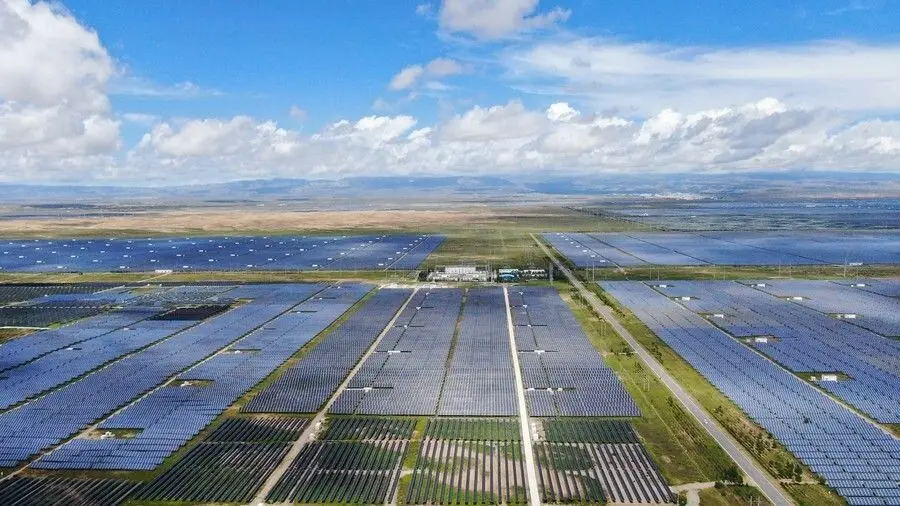
Aerial photo taken on Aug. 17, 2020 shows a photovoltaic power station, also a poverty-relief project, at the green industrial development park in the Tibetan Autonomous Prefecture of Hainan, northwest China's Qinghai Province. (Xinhua/Zhang Long)
IMPLICATIONS FOR THE WORLD
Calling China a "learner, beneficiary and innovator of global poverty alleviation theories," the report summarized foreign experts' views of Chinese inspirations for the world as "5Ds:" Determined Leadership, Detailed Blueprint, Development Oriented, Data-based Governance and Decentralized Delivery.
"There is no doubt that poverty alleviation is a vivid manifestation of the leadership of the CPC," the report highlighted the top leader's determined will, which creates a strong national will and drives the allocation of resources, as well as the leadership of the 91-million-member CPC.
With the common goal of eradicating absolute poverty, several generations of Chinese leaderships have drawn strategic blueprints and led the nation in successive struggles, which ensured policy continuity and spurred the entire country to work together toward a unified goal.
Meanwhile, China has long prioritized economic development in its poverty fight, which is combined with proactive, precise poverty reduction practices that directly pass on the benefits of economic development to every poor household and eliminate poverty completely.
Villager Mouse Labo takes photos of a camping tent to be rented to tourists in Atulie'er Village, Liangshan Yi Autonomous Prefecture, southwest China's Sichuan Province, Nov. 23, 2019. Mouse Labo shares photos and videos about the tourism information of Autlie'er Village via livestreaming, a way to promote his hometown's tourism. (Xinhua/Jiang Hongjing)
In the fight against poverty, the Chinese government has also attached particular importance to the development of big data and the digital economy and emphasized the application of advanced digital management, which made China's poverty alleviation success possible in a relatively short period of time.
Last but not least, the report attributed the effective implementation of poverty alleviation policies to the "decentralized" nature of China's governance structure, featuring many improvisations at subnational levels to implement national policies.
Besides experience sharing, China has committed itself to the global combat against absolute poverty by participating in assistance programs, supporting "capacity development" projects and advocating a shared-solutions approach, according to the report.
"China, based on its own experience and theoretical ideas in poverty alleviation, is giving back to the human cause of ending poverty and providing a new reference for other countries and regions," it said.
(Video Reporters: Xiao Sisi, Zhang Baokang, Zhou Hua; Video editor: Zhang Qiru, Liu Ruoshi) ■